Center Hill Solar Array


Center Hill Landfill presentation

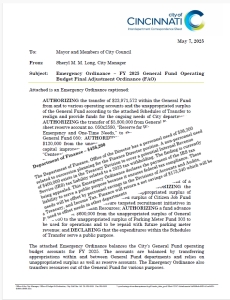
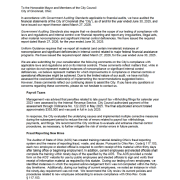
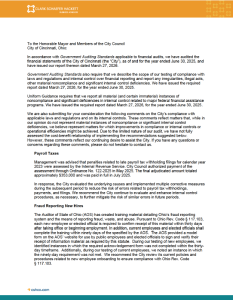
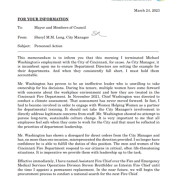
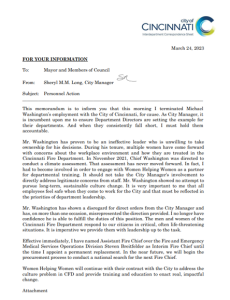
Center Hill Transmittal, city manager 


The city council is fixin to approve $12 million at tomorrow’s meeting (1.22.26) for another solar energy project.  Remember, the city already has the New Market solar farm. The location for this new project is the Center Hill landfill.

I’m still trying to gather information about what the city council is doing except it doesn’t seem that they’ve made a very good business case for spending $12 million.  By their own admission, it is all about the Green Cincinnati Plan and achieving “carbon neutrality” by 2050. Some, including me, call that a colossal waste of money.

We need to know what due diligence, if any, was carried out by the city council.  For example, good luck trying to find out performance or financial information about the city’s existing solar farm.  How is that working out? Is it performing as projected? Shouldn’t that part of the city council’s due diligence.

Twelve million dollars could cover a lot of neighborhood quality of life needs, maintenance and upgrade of public housing for seniors, food delivery programs. Or greater financial support for the pension system for city employees that is $800 million in the hole.  It just does not make sense to me.


The Status of “Cincy on Track.” (Spoiler Alert: We were right)


Cincy on Track 1.14.26

Cincy on Track Summary 1.14.26


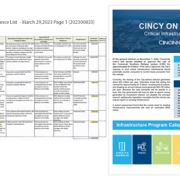
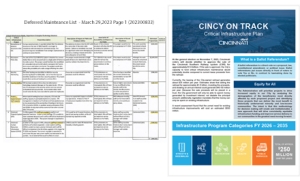
At today’s city council meeting, the city manager provided a report on “Cincy on Track,” which is the city manager’s plan to spend the Railway money . Maybe this was her response to all the bad publicity the city administration has been receiving about the lack of progress on infrastructure spending.  They were even scolded by former Mayor Luken.

The report is a 9 page list of projects, including their projected costs and status. The city manager neglected to provide a total number of projects on the list and also the total projected costs, so I asked ChatGPT to do that. It is also posted here.

As noted on the ChatGPT summary, the final list contains 158 projects with projected costs totaling $70 million for two fiscal years: FY25 and FY26.  That is $35 million per year.

In an odd coincidence, $35 million was the last annual lease payment that was offered by Norfolk Southern during negotiations in 2023, before the Board of Trustees agreed to sell the railway and the city council agreed to put it on the balllot.

As we have been saying, the city does not even have the capacity to spend $56 million per year on infrastructure projects. Unfortunately, as our parents used to say, “the city’s eyes were bigger than their stomach.” (Or is it “their noses are longer than Pinocchio’s?”)


What Happened to Cincinnati’s COVID $$$


We are looking into Cincinnati’s use of State & Local Fiscal Recovery Funds, which were the pandemic relief funds specifically directed to local governments

Most people are probably under the impression that the “COVID money” for cities were intended to help the cities just “keep the lights on.”  That is not the case.

The Treasury Department used a formula to determine what cities received, not a calculation of a city’s fiscal needs.  As a result, during the COVID years, Cincinnati received more than $150 million in discretionary funds to spend within very loose eligibility requirements.

This is Cincinnati’s original 2021 plan for the COVID money. A records request has been submitted for a more detailed accounting of how those funds were used.

Funding Priorities for Coronavirus Local Fiscal Recovery Fund 3.24.21

Funding Priorities for Coronavirus Local Fiscal Recovery Fund Attachment reconciliation highlighted

Funding Priorities for Coronavirus Local Fiscal Recovery Fund 4.8.21

Nonprofit Research and Transparency Websites


Nonprofit Research & Transparency Websites Final 12.31.25


One of the first things that got my attention with Cincinnati’s budget was the list of non-profit organizations that were receiving “leveraged support” from the city. I wondered then and still wonder now, how the city ensures that the money granted to these organizations is used for its intended purpose.

At one point, I counted nearly 200 non-profits getting funding from the city through one program or another.

As I looked at the list, I focused on two “leveraged support partners:” Cintrifuse and CincyTech.  Given their private sector purpose, I was curious why the city was giving them money – a total of $1 million or more, each, over the past several years.  Cintrifuse is a 501(c)(3) that helps entrepreneurs and start ups and CincyTech is a 501(c)(4) venture capitalist.

CincyTech’s IRS filings are not public, so I looked at the IRS filings for Cintrifuse. I immediately noticed that Aftab Pureval was listed on the IRS Form 990 as a member of the Board of Directors. What are the odds that I would find a problem with the first organization I looked at?

If you’ve been following along, you know that I have been working for many months including directly telling the mayor that I thought he should correct what looks like a clear ethics violation. As far as I know, nothing has changed.

To counter any assertions that I am against nonprofit organizations, you should know that according to the IRS there are approximately 2 million tax exempt organizations in the U.S. In Hamilton County, there are an estimated 10,000 or more.

In many cases in Cincinnati, non-profit organizations represent the city government outsourcing some of its functions, especially in the area of social services.  So, if you examine those non-profits and their use of public money, you’re likely to be accused of being a bad person, e.g. uncharitable or worse.

From what I am hearing, some are suggesting that is why the corruption involving public benefit fraud in Minneapolis went unabated for so many years.  Citizens knew but did not want to be accused of being a bad person if they raised their concerns to the authorities.

The point is that non-profit organizations require oversight just like governments.  If you are ever curious about a nonprofit this list of some of the public websites containing search tools for information and financial reports for nonprofit organizations, will be useful.

What did Cincinnati do with its COVID money?


SLFRF-2025-Recovery-Plan-Performance-Report_Monica-Morton

City-Of-Cincinnati-Ohio_2024-Recovery-Plan_SLT-1806


The city council covered a lot of ground about the city’s current and future finances during their two December meetings. The narrative about the projected $30 million budget deficit and the open talk about an earnings tax increase signal where the city government is headed – an earnings tax increase.

The narrative incudes repeated references to how the city no longer has COVID money. “Oh no! What are we going to do without COVID money?”  “I guess we just have to raise taxes. Isn’t it obvious?” At least that is what the politicians will likely be saying.

Keep in mind that, according to the mayor, the city has recovered from COVID. It is one of his major accomplishments. Presumably, that means that all the lost revenues experienced during COVID, are once again filling the city’s coffers.  Since the primary purpose of ARPA funds was “revenue replacement,” that must mean that the problem is solved. COVID money is no loger needed anyway, right?

Also, most people are under the impression that the city received ARPA money based on how much revenue the city was projected to lose as a result of COVID. But that is not how it worked. The ARPA funding was formula based. I haven’t looked at the formula itself, but formula funding is much easier to distribute and less strict about its use. Chances are that the ARPA funding was greater than needed to cover eligible costs and as a result, there was new or extra spending that occurred with COVID money.

So, we need to examine exactly what the city did with our COVID money.  How much of the COVID spending was “a must have” and how much was “nice to have.” The city was required to file annual reports with the federal government about its use of ARPA money. The 2024 and 2025 reports are posted above.

We will be examining the COVID funding issue and reporting back soon.  My sense is that our examination will provide greater clarity, at least for this part of the politicians’ (and the Cincinnati Futures Commission) “tax increase narrative.”

On December 28, 2025, I posted the following update about the city’s 2025 Covid report:

FB 12.28.25 Update about City Covid Report

Clermont Metropolitan Housing Authority Embezzlement


Southern District of Ohio _ Former Clermont housing official pleads guilty to federal program theft _ United States Department of Justice

The case is several years old, but the Ohio Auditor of State just issued a final report in June 2025. Since it is close to home, involving the (now former) director of the Clermont Metropolitan Housing Authority (CMHA), I thought people may be interested.  The case is also filed in the research library folder, “that’s where the money is.”

The defendant, Timothy Holland, was federally prosecuted for embezzling over $100,000, over a period of several years, simply using a CMHA credit card and also colluding with a CMHA contractor to build himself a “man cave” in his house, compliments of CMHA. Approximately $86,000 by credit card and $18,000 for the man cave.  If you do an internet search for Mr. Holland, you will find that all the local TV news and the Enquirer reported on the case, which is good.

It looks like somebody called the Hotline for the HUD Inspector General and “dropped a dime” on Mr. Holland. Good for them.

The Ohio Auditor of State and the Ohio Attorney General were also credited by the U.S. Attorney’s Office for the success of the case. The Auditor’s report is linked below:

Clermont_Metropolitan_Housing_Authority_17-19_Clermont_Special_Final_FINAL


Why did the city fire UC’s Economics Center?

When was the last time you heard anyone in City Hall criticizing the academic work of the University of Cincinnati for ANYTHING? And on top of that, have at least two members of city council cheering about it? Probably never before.

Well, that is what took place at the December 8th meeting of city council’s Budget and Finance Committee. The city’s new Finance Director essentially trashed the quality of UC’s economic forecasting and reported that he has instead brought economic forecasting “in-house.”   And you had Councilmembers Cramerding and Jeffreys crow about how great it is that the city has dumped UC.

That was it. No explanation of what the “dissatisfaction” withthe economic forecasting of our university was all about. Obviously, behind the scenes they all talked about it and decided the public did not need to know any more than that. I guess it is none of our business? I wonder what UC thinks about what was said?

I thought it was so outrageous that I’ve written to the Finance Director with a few questions (with a copy to the head of UC’s Economics Center).

In episode 41 of “Citizen Watchdog with Todd Zinser,” which is in the works, we are going to connect the dots about how bringing economic forecasting, in-house, is related to the projected deficit and the future “revenue enhancements,” e.g. tax increases, which were also mentioned quite matter-of-factly by the Finance Director .

UC’s Income Tax Forecast 2020 -2026 ; the Tentative Tax Budget presentation: and the email to the Finance Director follow:

UC’s Income Tax Forecast FY2022-2026


Presentation Tentative Tax Budget


Email to Finance Director 12.19.25

Putting the lie to the Sale of the Cincinnati Southern Railroad (12.10.95)


The city council made a lot of money decisions today (12.10.25). One of the big agenda items was “item 58”.  The top screenshot is Item 58 as it is presented in the city council’s official agenda.

Below is what Iten 58 looks like when you and ask AI to explain what it says.

Understanding that the official agenda probably has some legal purpose, the people (and probably even the city council members) would benefit from a simplified agenda made public at the same time as the official agenda is distributed.

Also, as a result, we would more easily see that there is $20 million in unspent capital funds this year.

Consider this, if we had negotiated a new railroad lease of $34 million annually, which was last negotiated amount before they decided to sell, and added $20 million to that, it would just about match the $56 million distributed to the city by the Railroad Trust Board this year.

AND WE WOULD STILL OWN A RAILROAD!

Former President and CEO of the Minneapolis Regional Chamber of Commerce Pleads Guilty to Fraud


I am including this case in my research library in the folder,” That’s Where the Money Is.”  The folder is a collection of cases of local public corruption from across the U.S.

This case involves the Minneapolis Chamber of Commerce which is not a local government but these days the line between government and non-profit organizations is becoming more and more blurred, especially here in Cincinnati.

Moving forward, we will be including reports about fraud involving non-profits in the folder.

In this case, the guy was very, very greedy. Most embezzlers have some human condition such as gambling or drug addiction, substantial debt, or the need to finance an extramarital affair, or some other secret life. This guy was making $275,000 a year but felt the need to embezzle another $213,000 to fund an even more privileged lifestyle.

He used 5 different embezzlement schemes over the course of several years. which is extraordinary.

By my count, Cincinnati grants funding to almost 200 non-profits (including 2 local Chambers of Commerce) with little or no oversight. As I have stated previously, in my view, the city’s practice of funding so many nonprofits is a high risk for fraud.


District of Minnesota _ Former President and CEO of the Minneapolis Regional Chamber of Commerce Pleads Guilty to Fraud _ United States Department of Justice

Common Fraud Schemes on Transporation Construction Projects

Whether it is the $1.6 billion Cincinnati Southern Railroad Trust and the “Cincy on Track Plan;” the $1.3 billion Brent Spence Bridge Project; the $400 million (and counting) Western Hills Viaduct Project; you can be assured that construction and procurement fraud will be with us in Cincinnati for years to come.

The fraudsters who are planning on illegal profits, from schemes that jeopardize the costs, schedules and integrity of our construction projects, are very likely already prepared for the public’s money to really start flowing.

Whether you are managing or employed on a construction project; or know someone who is; a supplier of construction materials; or is responsible for oversight of related projects, there are existing resources you can tap into to learn about the type of fraud schemes that are common on construction projects.

One of those resources is the U.S. DOT Office of Inspector General. The USDOT OIG has a history of promoting education and coordination among law enforcement, oversight agencies and the public in the area of transportation construction fraud.

For example, this is a link to a series of “Fraud Cards” published by the DOT OIG on their website that explain many of the common fraud schemes the OIG investigates:

https://www.oig.dot.gov/investigations/common-fraud-schemes

In addition, the Cincinnati Oversight Project is developing a public awareness campaign about fraud in transportation projects. Stay tuned for that.