Cincinnati council must attack pension liability more aggressively (Cincinnati Enquirer 12.1.24) Zinser Op-Ed 009

This op-ed focused on the council’s decisions on how to spend a $64 million budget surplus. My concern is that the council’s spending plan ignored the need to more aggressively reduce an $840 million deficit in the city employee’s pension fund, which is under a court order, and must be fully funded by 2045.

The Cincinnati’s Future Commission called the Cincinnati Retirement System’s pension liability, the greatest threat to the city. With more retirees taking than those contributing, before long. the costs of the pension liability will begin to crowd out other budget requirements.


Zinser OpEd Pension Liability

Landsman needs to explain why he failed to disclose stock trades (Cincinnati Enquirer 10.7.24) Zinser Op-Ed 008

There were reports in the news about Congressman Greg Landman’s failure to comply with the STOCK Act. (Stop Trading on Congressional Knowedge).

I was subject to the STOCK Act which became law while I was serving as the Commerce IG. I had to file a report anytime I bought or sold stock and I also had to report if I had any discussions with outside parties about post employment opportunties, which I had to do a couple of times. That provision did not apply to Members of Congress.

In the case of Mr. Landsman, he served practically his entire first term (2 years) in non-compliance with the STOCK Act. During his first term, his account was being actively trading, including substantial holdings in industries that he self-rightously campaigned against. In other words, a 100% hypocrite.

I thought it warranted a review by the Office of Congressional Ethics for the House of Representatives, so I filed a complaint alleging that Mr. Landsman, by his years-long non-compliance, “brought disrepute on the House,” something that is punishable under the House rules.

As far as I know, nothing became of Mr. Landsman’s potential penalties under the Stock Act or my ethics complaint. Nonetheless, he brought disrepute upon himself and the people of Congressional District 1 and he needed to be called out.

Opinion_ Landsman violates STOCK Act by not disclosing stock trades

City must tell ‘victims’ of VineBrook Homes why settling lawsuit is a good idea. (Cincinnati Enquirer 8.30.24) Zinser Op-Ed 007

I try to attend the West Price Hill Community Council meeting every month. At one meeting, a resident stood up and raised many concerns about “VineBrook.” I learned that VineBrook was a large institutional investor in rental housing, that owns many rental properties in Cincinnati and Hamilton County. He complained about the failure of VineBrook to maintain their properties and how that was affecting the neighborhood in a negative way.

As it turns out, the city had filed a lawsuiit against Vinebrook in Hamilton Count Court of Common Pleas. There were news reports about a settlement in the case an given the concerns raised at the community council meeting, I took a look at the case and the settlement documents.

The first thing that came to mind was that the solicitor’s office must have been pressured to file the lawsuit. The settlement terms basically provided none of the relief sought by the city and in some ways made the city look like the offending party.

Cincinnati owes public an explanation for Vinebrook Homes settlement

Raising taxes amid high inflation is a bad idea for Cincinnati (Cincinnati Enquirer 7.30.24) Zinser Op-Ed 006

Raising Cincinnati’s earnings tax a bad idea amid record inflation

Bad handling of Connected Communities didn’t improve public’s trust in City Hall (Cincinnati Enquirer 6.18.25) Zinser Op-Ed 005

This editorial was the second one submitted about Connected Communties. I wanted to continue on trying to unmask  Connected Communities as an “ideological,” top down, zoning reform and not a policy that is based on grass roots “community engagement.” I wondered whether Columbus and Cleveland were enacting “upzoning” ordinances and sure enough, they were. That seemed important to tell people.  The entire way that the mayor, the council and the city manager handled Connected Communities was, for lack of a better word, dishonest. Just like the sale of the railroad.  That is what this Op-Ed is about.


Connected Communities an unproven housing solution driven by politics

City fails to give full picture of zoning reforms (Cincinnati Enquirer 4.14.24) Zinser Op-Ed 004

I received a call one afternoon from a neighbor. She had been speaking with another neighbor about the meeting of the West Price Hill Community Council the night before. They discussed information presented at the meeting about “Connected Communities.” She wanted to know what this was all about?

Even though I had been at the meeting, I had to admit that other than it being some type of zoning proposal, I did not really understand what it was all about. But I promised to look into it.

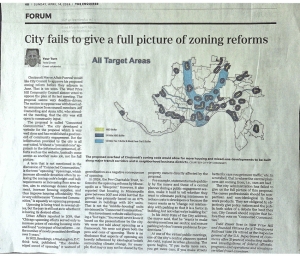
When I serached the internet for “Connected Communities,” the only thing that came up was information about Cincinnati’s proposal. So, I went to a website of one of the national organizations for cities and municipalities ( a ‘special interest group’ ) to see what I might find. What I learned is that Connected Communities is what is called “Upzoning” and numerous cities across the country were enacting zoning laws that were “upzoning” single family zones to multi-family zones. The putpose was to achieve greater density by squeezing more housing into neighborhoods. Minneapolis, for example, eliminated all single family zoning in the city.

It seemed to me that the city was again hiding the big picture from the city residents and was engaged in a public relations effort instead of true community engagement. This Op-Ed was an attempt to blow the whistle on the true nature of the Connected Communities proposal.


City leaders doing a sales job on proposed zoning reforms _ Opinion

Without oversight,$1.6 billion railroad fund ripe for mismanagement (Cincinnati Enquirer 12.21.24) Zinser Op-Ed 003

This Op-Ed was a second attempt at getting additional controls over the trust fund and the city’s spending.  The recommendations were: 1) establish a permanent baseline for capital spending at the FY 2004 level; 2) the board of trustees should use its discretion over the amount it disburses to the to city so as to ensure that funds are properly spent; 3) the trustees should employ a compliance officer who would promote compliance at the Board of Trustees as well as the city, with respect to the Trust and the proper use of its investment proceeds. Nothing like that has been done.


Waste, abuse threaten $1.6 billion railroad fund without oversight

Railroad Sale Opponents don’t want to say, ‘we told you so.’ (Cincinnati Enquirer 11.17.23) Zinser Op-Ed 002

I thought selling the Cincinnati Southern Railway was a bad idea for many reasons. A big reason in particular was all the compliance and oversight issues that have been created as a result of the sale. They include both the investment of the $1.6 billion as well as how the proceeds of those investments are spent. The point is that from now on, if we want to preserve the Trust Fund and actually tackle the list of “$400 million” in deferred maintenance, we will have to be always vigilent.

Under the annual lease, it was a very simple transaction every year. It was one transfer every year of a lease payment required by contract. Since the sale was approved, we have already had to push back on the creation of a “Rising 15 Railroad Fund.”  The proposal was to divert 10% of the annual trust fund earnings to a special fund for 15 “underserved neighborhoods.” That has not happened – yet.

There was also a push during the 2026/2027 budget formulation process to establish a “Sidewalk Repair Pilot Project.” The project would use railroad money to relieve property owners, in 7 underserved neighborhoods, of the responsibility of repairing the sidewalks.  I requested a copy of any legal analysis that was produced concerning the proposed pilot program, but the city refused to disclose it. They cited “attorney-client privilege,” In the end, the council decided (for now) not to use railroad money for the pilot program.

Anyway, this Op-Ed was submitted soon after the referendum passed. I recommended putting additional controls on the managment of the trust fund and the city’s use of the proceeds.


Issue 22 passed. Cincinnati must do 5 things for railroad sale to work

Proposed railroad sale at risk due to lack of education (Cincinnati Enquirer 9.15.23) Zinser Op-Ed 001

When it came out that the mayor wanted to sell the Cincinnati Southern Railway and that the entire city council and the Trustees of the railway were all in agreement, it did not sit well with many of us.

These politicians, who are here one day and gone the next, wanted us to give up an asset that the city had built and owned for 130 years to make up for the mis-management of previous city councils who ignored the maintainence needs of the city’s infrastructure.

On top of that, both the city and the Board of Trustees were suggesting that the municpal code prohibted any involvement of the city in the referendum. The citizens were on their own to figure out what was going on. The Railway Board took the same position.

That was such a blatant misinterpretation of the rules that I wanted to call them out about it. I thought we needed a public debate about the issue and that the city and the Railway Board needed to be part of that debate.

In the end, the sale did wind up to be hotly debated, including a public debate hosted by the Enquirer at Union Terminal.  The sale was narrowly approved by the voters 51.5% to 48.4% with 83,732 votes cast.

The public debate must have made Norfolk Southern nervous. Unbeknownst to us, until after the election, Norfolk Southern wound up spending $6 million on their campaign to convince voters to approve the sale.  That amount is reportedly 3 x the previous record of campaign spending in a Cincinnati election. Remarkably, not a sole on the city council raised any concrerns about all the money spent by Norfolk Southern. All for one and one for all.

Episode 18 of “Citizen Watchdog with Todd Zinser,” discusses the $6 million at greater length. It’s called “The Great Cincinnati Train Robbery.”


Railroad sale at risk due to lack of voter education _ Zinser Op-Ed (9.15.24)