
Eastside Flood Mitigation-Can Railroad Money be Used?
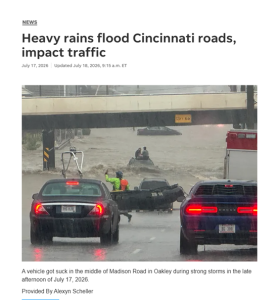
When Eastside neighborhoods were once again seriously and fatally flooded last week, I wondered what capital projects the city had underway or planned for flood mitigation on the Eastside. The short answer seems to be, not many.
In the 6-year (2026-2031) Capital Improvement Program (CIP), enacted in June 2025, there are 111 sewer-related projects, city-wide, totaling more than $1 billion for that period. That list includes 7 projects in Mt. Lookout, Hyde Park, Oakley and Madisonville, with an estimated total cost of $14.6 million, not necessarily for flood mitigation.
I also looked at a 2023 spreadsheet of the top 10 “Critical Infrastructure Needs,” identified by each of 5 city departments. The spreadsheet was compiled by the City Manager in response to an October 25, 2022, motion by the city council (202202015). The total estimated cost for those critical infrastructure needs was $255,280,000. But the list excluded MSD, GCWW, and SMU. Why?
I also looked at the “Cincy on Track” plan to determine whether the City planned to use the railroad money for costs associated with flood mitigation in these or any other neighborhoods. There is no mention of flood mitigation in Cincy on Track,
For those businesses and residents in those neighborhoods that were flooded last week, they know that it does not take a 1000-year rainfall to cause flooding to their properties. Flooding is a chronic problem for them.
Apparently, city officials must have discussed the issue amongst themselves and decided that MSD, GCWW and the SMU are not going to be using any railroad money for capital projects. You may be as surprised as I was to realize that the City’s plans for using the Railroad Money do not include sewer projects or flood mitigation. Afterall, it is existing infrastructure, maybe more than 100 years old.
Perhaps it has something to do with the fact that GCWW and MSD are restricted enterprise funds, which means that they are funded by user fees. They are supposed to be self-sufficient. But both MSD and GCWW receive state and federal grant funding. Why not railroad money as well?
In fact, the April 2026 budget presentation of the Stormwater Management Utility cited 3 challenges: 1) fragmented management structure; 2) lack of a strategic comprehensive plan; and 3) financial constraints and rising costs. In other words, SMU needs the money.
The issue may also be complicated for MSD based on governance issues. Hamilton County apparently owns MSD, but Cincinnati operates the system.
Has there been a legal determination that infrastructure projects in MSD and GCWW are not eligible to receive Railroad Money or is it based on a policy decision made by “who knows who?” Those Eastside neighborhoods should find out the answer.
CIP Analysis for Sewer-related projects 2026-2031
Critical Infrastructure Report 202300833
City-of-Cincinnati-FY-2026-2027-Biennial-Budget-Vol-II-Capital
Cincy on Track Map of Projects by neighborhood
FY 27 GCWW SMU Budget Presentation Challenges

