
Readng the Fine Print: Item 79
Issue-22-passed.-Cincinnati-must-do-5-things-for-railroad-sale-to-work
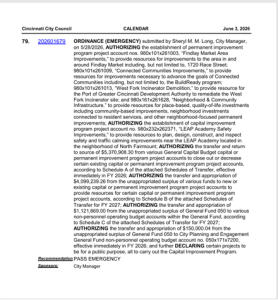
The agenda for the June 3, 2026, city council meeting is very long but it is Item 79 (the last item) that got my attention. It basically reprograms more than $5 million in capital funds from existing capital projects to the general fund and then back out to other supposed capital projects. But during the course of those transfers, more than $1 million will be shifted to cover operating costs, not capital projects.
Eventually, I suspect that this type of transferring money around will involve railway money. We all suspect that the city will try to use railway money for some big. ineligible project like an arena. But while that is very possible, I think it is more likely that the city will seek ways to use the railway funds to free up other capital money to cover operating costs elsewhere in the budget, which is what Item 79 does, but for now, with non-railway funds.
That is why I have recently been advocating that the city be required to maintain a separate ledger for tracking any transfers between projects and accounts when it involves railway money. Otherwise, this “operational loophole,” can circumvent the lone “internal control” contained in the law, the “existing infrastructure” provision. It would be very tedious to audit such transfers without a separate accounting ledger. Maybe that was the intent of those who wrote the legislation. Who knows?
After the railway sale, in an Op-Ed in the Enquirer on November 17, 2023, I also advocated that the city council establish a “floor” for the Capital Improvement Program based on FY24 funding levels, i.e., CIP funding level would never go below the FY 24 level. My point was that new railway proceeds should be added to the existing Capital Improvement Program funding level in order to ensure that there is an increase in spending on deferred maintenance, which during the campaign, was described by the mayor as a “crisis.”
I reasoned that establishing such a floor was the only way to guarantee that the city was going to devote the money necessary to tackle the estimated $400 million backlog in deferred maintenance . That backlog was the entire basis for selling the railway.
I think that as soon as the referendum passed, that deferred maintenance list went straight into the circular file or someone’s bottom desk drawer, never to be seen again. Item 79 does not involve railway money as far as I can tell. But this is how the city will bleed the railway trust money away,
As I noted in my Op-Ed, the city manager already publicly contemplatedmoving existing capital funding to the operating budget. And the Cincinnati Futures Commission is recommending the same thing.
To those of us who opposed the sale of the railway, this will come as no surprise.

